01
Custom software development
Applications shaped around a specific operational process where general-purpose tools force the business to work against itself.
Information technology
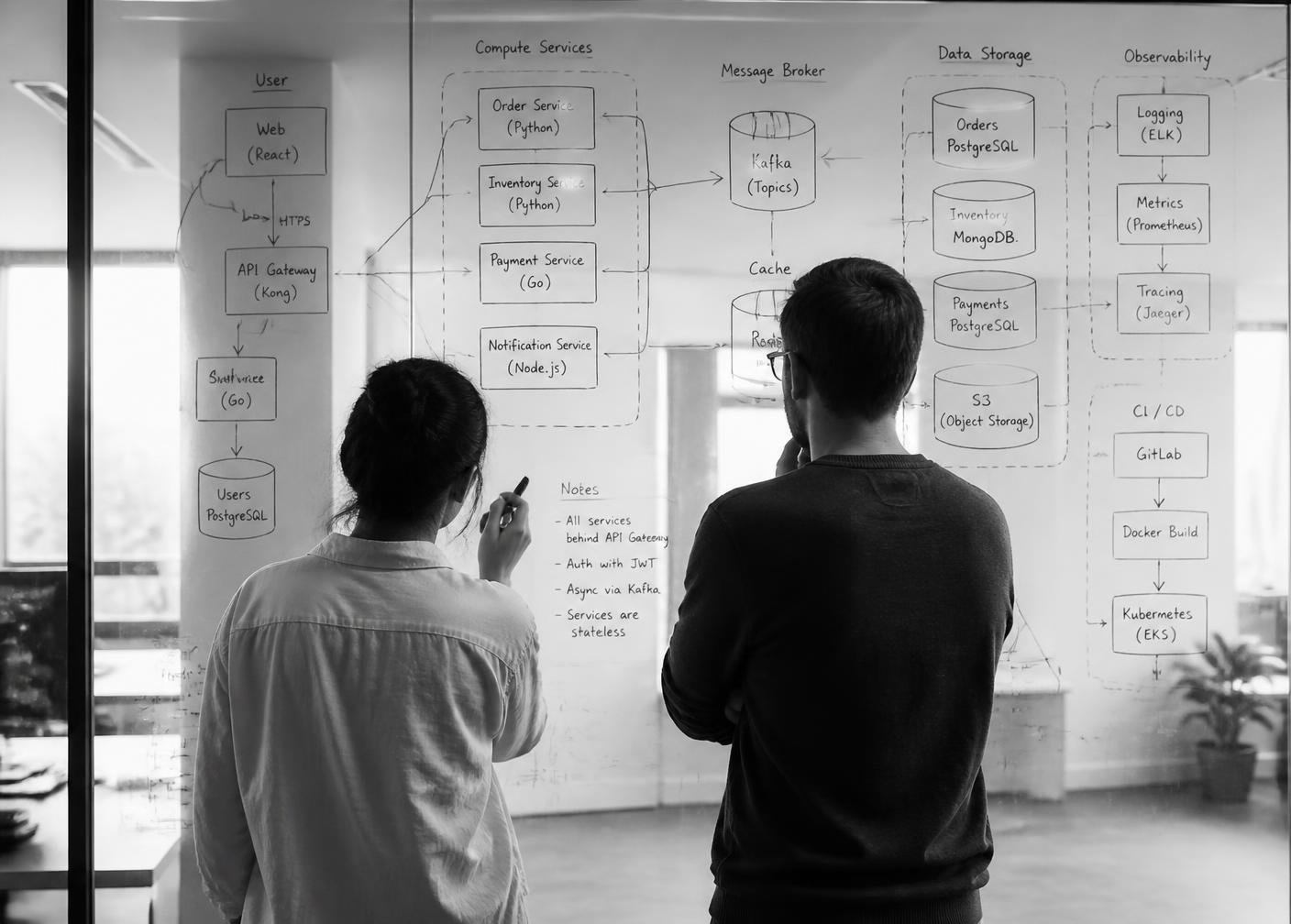
BOOK A PARTY DJ LTD builds and maintains software, cloud environments and infrastructure for organisations whose daily operations depend on technology behaving predictably.
Custom software · Web applications · Cloud · Integration · Infrastructure support · Security guidance · Data and automation

02 / Overview
Most business technology is not built from nothing. It arrives as a mixture of applications bought at different times, spreadsheets that quietly became critical, and integrations written by people who have since moved on. Useful engineering work starts by accepting that inheritance.
The company works in that setting. Engagements begin with reading the existing systems rather than proposing to replace them, continue through work that is scoped small enough to be reviewed honestly, and end with documentation and a maintenance path so the result does not depend on any single person's memory.
Decisions are recorded in writing, including the ones that turn out to be wrong. That record is what allows a system to be changed safely two years later.
03 / Services
01
Applications shaped around a specific operational process where general-purpose tools force the business to work against itself.
02
Browser-based systems for internal operations and customer-facing services, built for accessibility and long-term maintenance.
03
Environments designed, provisioned and documented so capacity, cost and recovery behaviour are all understood before production.
04
Reliable data movement between applications that were never designed to speak to one another, with failure handling written in.
05
Independent review of architecture, tooling and delivery practice, with findings written as options and trade-offs rather than verdicts.
06
Monitoring, patching, backup verification and capacity review for the systems that daily operations run on.
07
Practical hardening of access control, secrets handling, dependencies and logging, prioritised by realistic exposure.
08
Pipelines, reporting foundations and removal of repetitive manual steps that introduce errors at volume.
04 / Sectors
The work is not tied to a single sector. It suits organisations where a process has outgrown the tools supporting it.
05 / Problems
Symptoms described by
operations teams
Two systems hold the same records and neither is authoritative, so staff reconcile by hand and errors surface downstream at month end.
The original author has left, there are no tests and no documentation, so every change carries unknown risk and is therefore avoided.
Environments were provisioned quickly and never reviewed. Idle resources, oversized instances and forgotten storage accumulate quietly.
Numbers are assembled manually from several exports, so by the time a report is ready the decision window has already closed.
There is no meaningful monitoring or alerting, so the first signal that something has failed comes from outside the organisation.
A process that worked at ten transactions a day becomes the constraint at a thousand, and adding staff no longer resolves it.
06 / Method
01
Read the existing systems, interview the people who use them, and write down constraints, dependencies and the outcome being sought.
02
Break the work into pieces that can each be reviewed and reversed. Agree what done means for every piece before starting.
03
Choose the smallest structure that satisfies the constraints, and record why alternatives were rejected.
04
Implement in short cycles with version control, tests around behaviour that matters, and review of every change.
05
Test against the agreed definition of done in an environment that resembles production, including failure paths.
06
Deploy with monitoring and a rollback path, hand over documentation and access, then maintain by agreement.
07 / Capability
Tooling is selected for the problem in front of it. A technology is only worth adopting when the team that will keep it running can reasonably support it.

08 / Principles
Access is granted to the narrowest scope the work requires and reviewed when responsibilities change. Shared credentials are avoided.
Configuration and credentials are held in managed secret storage, injected at runtime and rotated when exposure is suspected.
Backups are only meaningful once a restore has been performed. Recovery steps are written down and rehearsed.
Timeouts, retries with limits, and clear degraded behaviour are part of the design rather than an afterthought.
Type checking, linting and tests run on every change so regressions are caught before review rather than in production.
Only data with a purpose is collected and retained, and production data is reduced or masked before it reaches development environments.

09 / Considerations
Scope, assumptions and decisions exist as documents, so agreement is verifiable rather than remembered differently by each side.
Work is delivered in pieces that can be inspected and, if necessary, undone. Progress is observable rather than reported.
Documentation, credentials and repositories belong to the organisation. Continuing the relationship should be a choice, not a necessity.
Replacement is a last resort. Where systems still serve their purpose they are integrated with rather than discarded.
Discussion happens with the people doing the work, in plain English, without an account layer translating between them.
Where an approach carries risk or a request is outside the practice's competence, that is stated rather than absorbed silently.
10 / Questions
01
Work centres on business software: custom applications, web platforms, cloud environments, integrations between existing systems, and the ongoing maintenance those systems need once they are live.
02
It begins with a written discovery conversation about the current systems, the constraints around them and the outcome the organisation wants. That discussion produces a scope, a sequence of work and an agreed definition of done before any code is written.
03
Yes. Engagements are often shared with in-house engineers or an incumbent supplier. In those cases responsibilities, review points and handover expectations are written down at the start so that ownership is never ambiguous.
04
Older systems are treated as a constraint to be understood, not an obstacle to be discarded. Where a replacement is genuinely warranted, migration is staged so that the business keeps operating throughout.
05
Access is limited to what the work requires, credentials are never shared outside agreed channels, and production data is not copied into development environments unless it has been reduced or masked first.
06
Delivery includes documentation, monitoring and a maintenance path. Where an ongoing arrangement is agreed, that covers dependency updates, performance review and correction of defects found in normal use.
11 / Contact
Written enquiries are read in English. Please include the systems involved and the outcome you are trying to reach; that is enough to establish whether the work is a reasonable fit.
Technology is only useful when it holds up on an ordinary day. That is the standard the work is measured against.
BOOK A PARTY DJ LTD — Statement